One of the highlights of walking the Via Podiensis (GR65), the French Camino de Santiago route from Le Puy-en-Velay, is the beautiful village of Estaing.
Most pilgrims pause on the medieval bridge to admire the view, take a photograph, or simply soak in the atmosphere of one of the most beautiful villages on the route. Yet few realize that the cross standing on the bridge has a remarkable story involving a Parisian jeweler, a government ministry, and a secret nighttime operation.
The Estaing Cross has become one of the most recognizable symbols of the village, and the gold pendant it inspired is known throughout France. But the cross we see today is not the original.
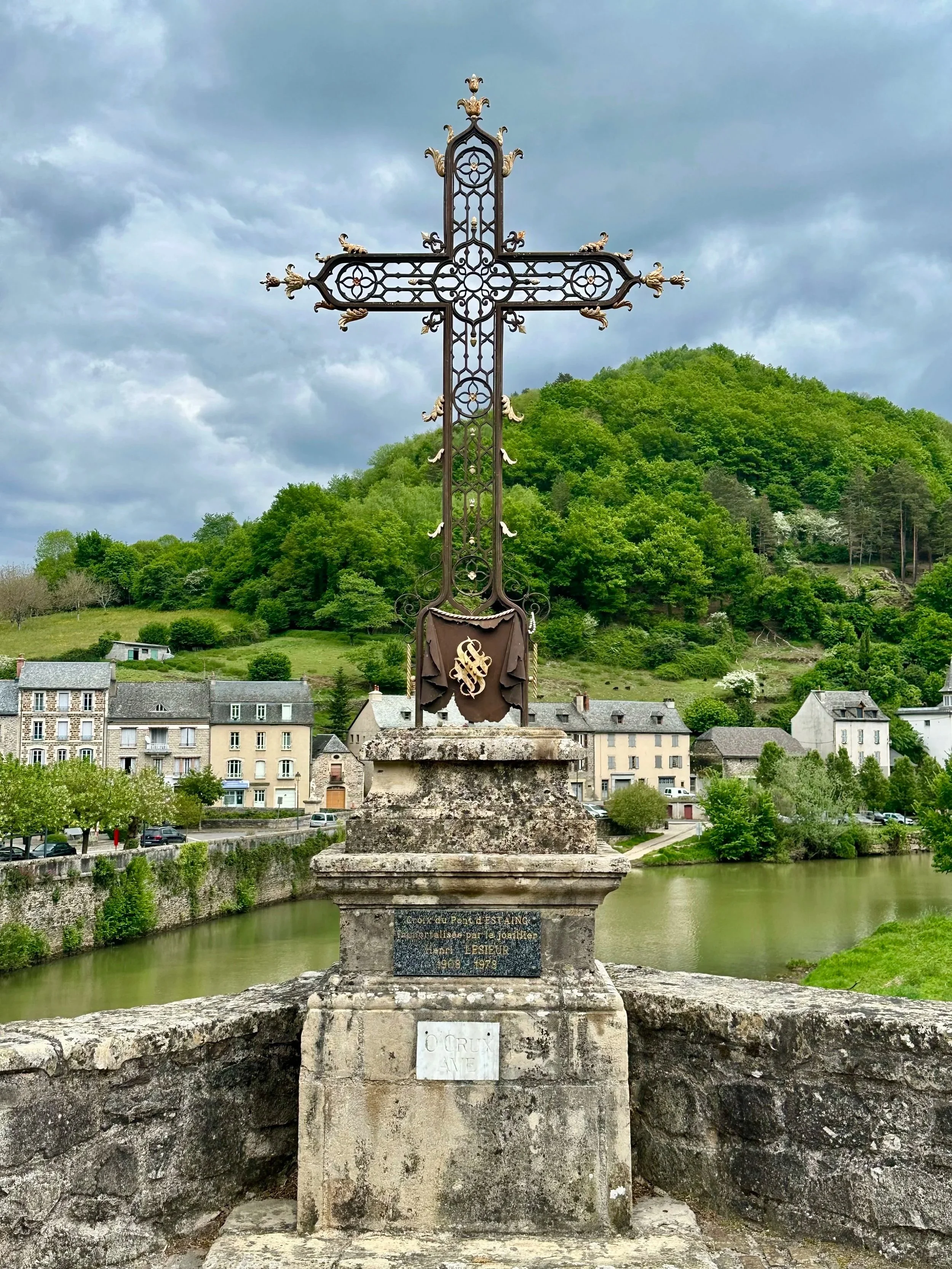
The Estaing Cross on the medieval bridge in Estaing.
What Is the Estaing Cross?
The story begins in 1835, when a cast-iron cross was placed on the bridge crossing the River Lot in Estaing.
For more than a century, pilgrims, villagers, and travelers crossed the bridge beneath its distinctive silhouette. Then, in the late 1950s, a Parisian goldsmith named Henri Lesieur noticed the cross and was inspired by its elegant design.
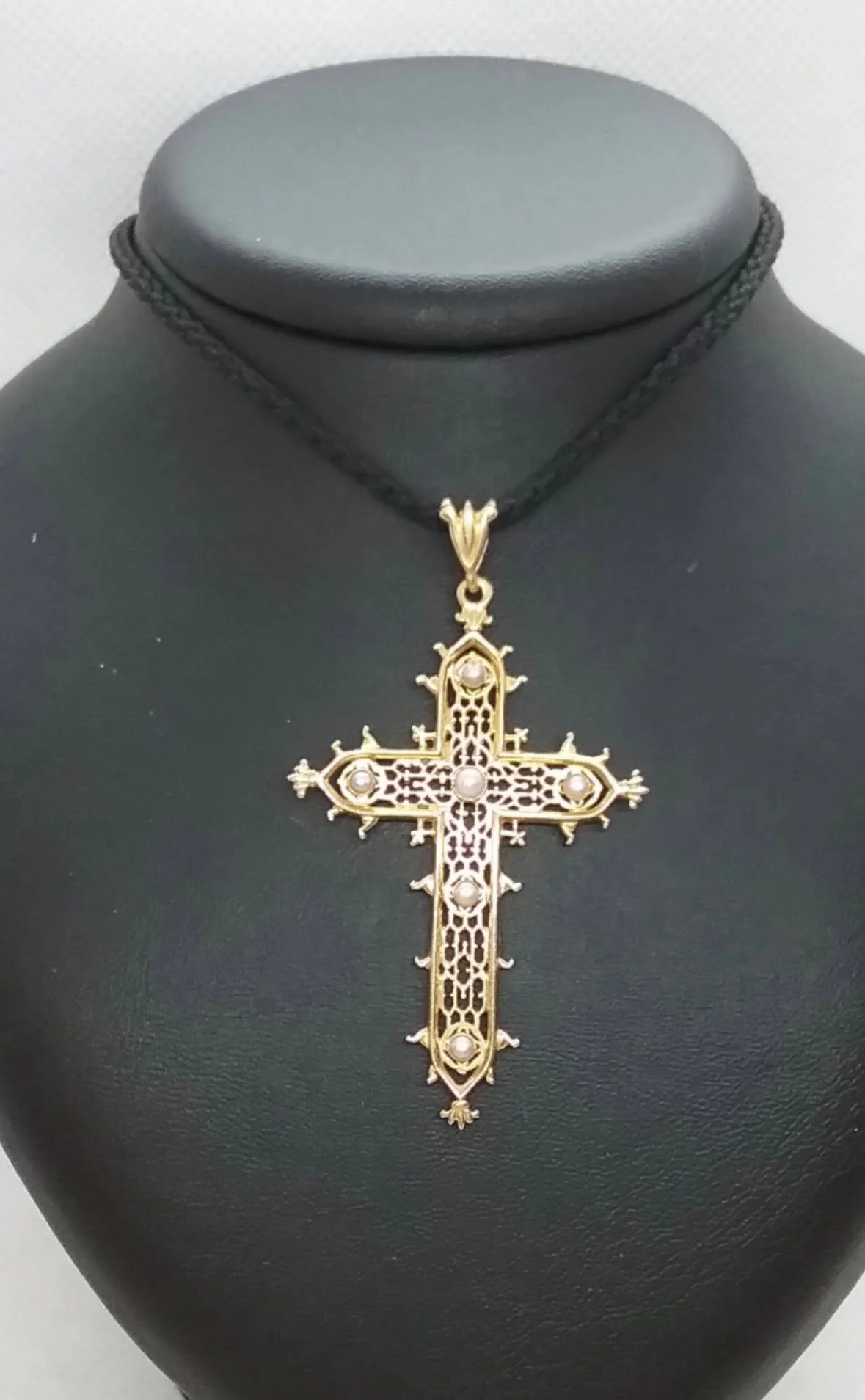
He created a gold pendant based on its shape.
The pendant quickly became a success.
Demand grew rapidly, and before long the Estaing Cross was being worn throughout France.
The Estaing Cross pendant created by Parisian jeweler Henri Lesieur, inspired by the cross on the bridge at Estaing.
Why Was the Estaing Cross Replaced?
The success of the pendant brought unexpected attention.
In the documentation accompanying the jewelry, the original cross was described as fer forgé — wrought iron.
Unfortunately, this was not true.
The bridge cross was actually made of cast iron (fonte), not wrought iron. The discrepancy came to the attention of a government ministry, and accusations of false advertising followed.
Henri Lesieur found an ingenious solution.
Rather than change the description of the pendant, he arranged and paid for a new cross to be made in genuine wrought iron. The replacement was slightly larger than the original and closely resembled it in appearance.
On the night of 13 August 1960, the new cross was quietly installed on the bridge.
According to local accounts, the operation was not without drama, and the original cross apparently came rather close to ending up in the River Lot during the replacement process.
The following evening, the new cross was blessed by the Bishop of Rodez. Most local residents assumed it had been donated as part of the celebrations marking the 500th anniversary of the birth of François d'Estaing.
Few knew the real reason for its appearance.
The Original Cast-Iron Cross
The cross that inspired the famous pendant no longer stands on the bridge today.
What pilgrims see when they walk through Estaing is the wrought-iron replacement installed in 1960. The original cast-iron cross survives only in photographs and local memory.
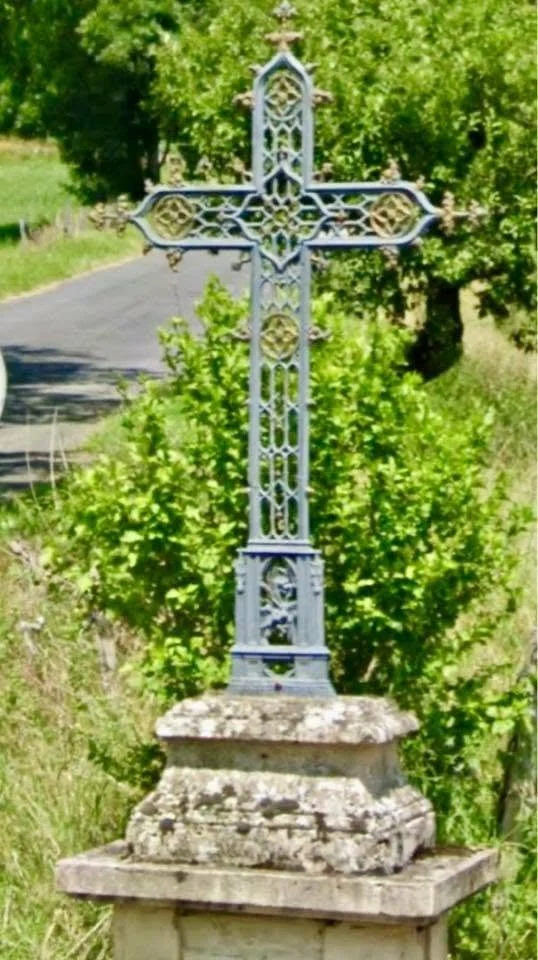
The old cast-iron cross has been relocated at the intersection of the Annat and Nayrac roads, just a few kms out of Estaing village.
The original cast-iron cross that inspired the famous pendant. It stood on the bridge until it was replaced in 1960.
Where Can Pilgrims See the Estaing Cross?
Pilgrims walking the Via Podiensis (GR65) encounter the cross while crossing the medieval bridge into Estaing, one of the most beautiful villages on the Camino de Santiago in France.
The village lies between Saint-Côme-d'Olt and Golinhac and is often remembered for its château, narrow medieval streets, and stunning position beside the River Lot.
Many walkers stop here to admire the view. Yet hidden in plain sight is one of the most unusual stories on the route.
The cross that stands on the bridge today owes its existence not to a religious foundation, a local benefactor, or a historic restoration project, but to a jeweler's determination to resolve a dispute over the wording of a product description.
Stories like this are part of what makes walking the Via Podiensis so rewarding. Beyond the landscapes and practical stages, the route is filled with unexpected history waiting to be discovered.
Stories like this are one of the reasons I keep returning to the Via Podiensis. The path always has something new to reveal.
Walking with you,
Kate

Make it stand out
About the Author
Kate Forrester has walked the Via Podiensis multiple times since 2015 and is the founder of Camino Way of Life. She shares practical advice, local history, and the stories that make this pilgrimage route so special.
For more Camino resources, visit Camino Way of Life.
Buen Camino,
Kate