The village of Conques, in the south of France, is one of the most memorable stops on the Via Podiensis—the Le Puy route of the Camino de Santiago. At its center stands the Abbey Church of Sainte-Foy, known for its Romanesque architecture and the contemporary stained glass windows created by Pierre Soulages.
This reflection explores those windows—not as something to look at, but as a way of experiencing light and space differently.
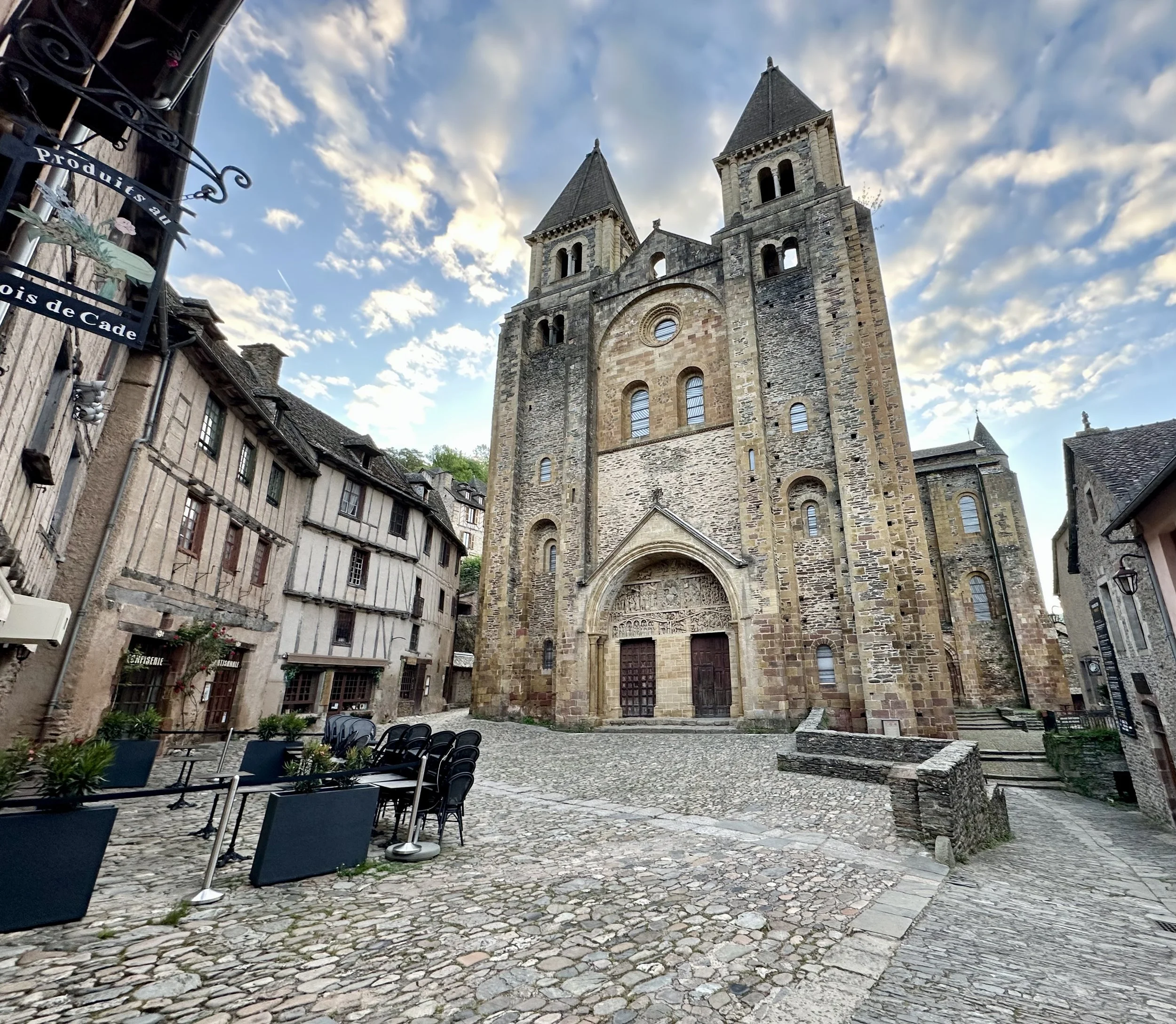
Abbey Church of Sainte-Foy in Conques, France on the Via Podiensis pilgrimage route
There are places that ask something of us before they reveal themselves.
Conques was one of those places for me.
First Encounter
The first time I entered the Abbey Church of Sainte-Foy, eleven years ago, I knew the windows were by Pierre Soulages. A painter who spent much of his life working with black—not as absence, but as a way of revealing light. What he called outrenoir—beyond black.
But I didn’t know how to approach the windows.
I found myself looking directly at them—trying, quietly, to understand what I was seeing.
I didn’t yet realise that they were not the place to look.
I had lived for years in Paris, returning again and again to la Sainte-Chapelle and its exceptional stain-glass windows, letting myself be overwhelmed by its soaring walls of color—those deep blues, those burning reds, the stories unfolding in light.
And I have always been drawn to Marc Chagall—to his colours, their vibrancy, the way they seem to carry something alive within them.
So standing in Conques, I was waiting—perhaps without knowing it—for something similar to happen.
It didn’t.
At least, not in the way I expected.
And yet, something must have stayed. Because years later, I found myself returning—not only to Conques, but to those windows.
And this time, I came with a question. I reached out to a friend of mine, someone who deeply loves Soulages. Someone who, after a long life working in the world of computers, chose to begin again—to learn, patiently, the craft of stained glass. To work with light, not code. It felt like the right bridge between my incomprehension and something I sensed I was missing.
Pierre Soulages and the Language of Light
Soulages did not create windows to be seen. He created windows to be lived with.
The glass he designed for Conques does not impose colour onto the space. Nor does it tell stories or draw the eye into narrative. Instead, it receives the light and transforms it—softly, almost imperceptibly.
A milky, textured glass.
Nearly colourless.
And yet never empty.
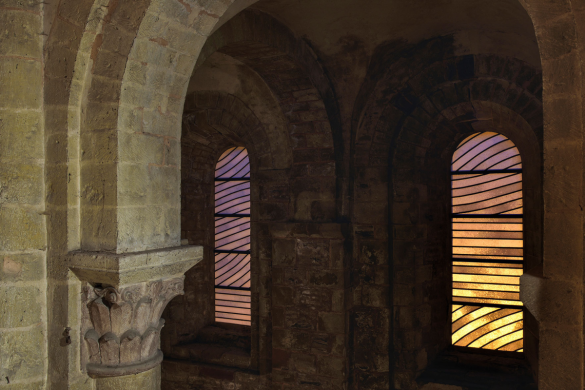
Interior of Abbey Church of Sainte-Foy in Conques with Pierre Soulages stained glass windows
The light enters, but it does not shout. It diffuses, settles, breathes.
It changes with the hour, with the weather, with the season.
Sometimes it feels like mist.
Sometimes like ash.
Sometimes like a quiet presence you cannot name.
And slowly—very slowly—you begin to notice something unexpected: It is not the windows that ask to be seen. It is the space that begins to reveal itself through them.
The sandstone walls of Conques seem to awaken under this light.
The volumes of the church become more tangible.
Shadows deepen.
Silence thickens.
The architecture, no longer competing with color, begins to speak in its own language.
There is a kind of humility in these windows.
A refusal to decorate.
A refusal to impress.
They do not try to give you something.
They wait for you to arrive differently.
And perhaps that is why I could not see them, at first. I was still looking for something to look at.
How to Experience the Windows in Conques
But these windows ask for something else.
To begin to sense it, you have to return.
Go in the afternoon, when the light is fuller, more present.
Go again in the evening, during the organ concert, when sound and light begin to meet.
And if you can, go in the morning, when everything is still soft, almost untouched.
Something changes each time.
Not only in the light— but in you.
Now, when I return to Conques, I no longer compare them to the brilliance of Sainte-Chapelle or the colours of Chagall.
They belong to another world entirely.
Not the world of image,
but the world of presence.
You don’t look at the light.
You find yourself inside it.
Kate Forrester walks the Via Podiensis and writes from the experience of the path—where landscape, silence, and inner life meet.